

Another World Is Possible(?)
🌍

Twenty years ago, on March 20, 2003, a full moon night, the United States of America and its allies launched the invasion of Iraq to overthrow President Saddam Hussein and his regime.
There’s nothing intelligent to say about a massacre, wrote Kurt Vonnegut.
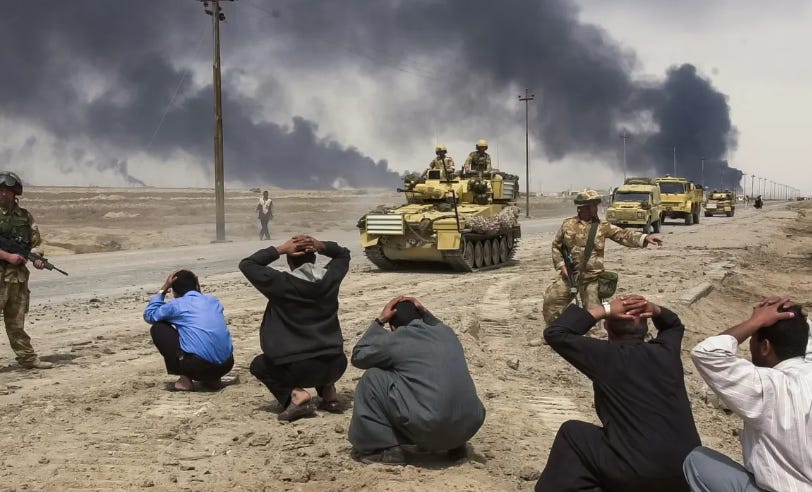
In hindsight the Iraq war was a bad war, if a war can be anything other: fought on the premise of lies, based on money interests and a desire to keep a death grip on dwindling oil reserves. The war cost 210,000 civilian lives. U.S. forces detained and tortured thousands of Iraqis in places like Abu Ghraib, up to 90% of whom it was later revealed were arrested by “mistake”. 1 out of 5 Iraqis were displaced, 9 million in total: the largest human displacement on record (after the expulsion of Palestinians in 1947). In one sense, for many the war isn’t even over: 1.2 million Iraqis remain internally displaced.
Meanwhile, as of this weekend, the U.S. has resumed attacks on the ground in the Middle East, in Syria, in the name of targeting groups with links to Iran.
The best we can say under the circumstances: Is it possible to avoid another bad war, without end — based on shortsighted, stupid economic interest?
How much has been wasted in that vein?
Another Stupid War
Already there’s a lot of money on the line for our new war — for Ukraine — to the tune of $1.7 trillion promised by Congress, and $2.8 trillion in global economic losses last year. An opinion piece in the NYT poignantly pointed out the financial toll is nothing compared with the human cost of war: displacement, lost childhoods, and a death toll in the hundreds of thousands (if you count dead conscripted Russian soldiers).
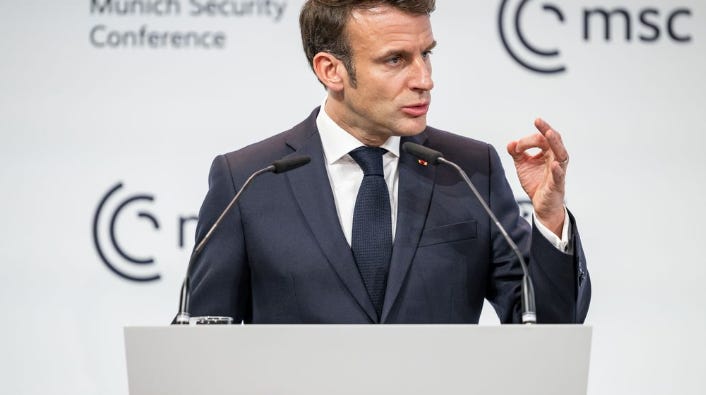
At the Munich Security Forum in late February, leaders publicly exuded “confidence and resolution”, calling “onwards to victory.” The Financial Times reported, more privately, those backing the war are growing concerned: who currently has the upperhand on the battlefield? Can Russia be brought to accept peace on the terms of Ukraine and the West? If the war drags on, will the West support the effort financially without limits?
“The western alliance, which spent much of the cold war worrying about Russian tanks sweeping across Europe, discovered Russia cannot even take and hold Kharkiv, a city 50km from its border. But while the Russian military has performed worse than expected, the Russian economy has performed better.
When western sanctions were imposed, it was widely predicted that Russia would suffer an economic contraction of 20 per cent or more. [Instead its economy has] shrunk by about 3-4 per cent. By contrast, the Ukrainian economy is in deep trouble and dependent on western aid. For this reason, influential western analysts argue that time is not on Ukraine’s side — and that if Kyiv is to win, it must do so quickly.” (Financial Times)
The conference concluded Ukraine will be given any support necessary for a spring offensive. Hopes ran high Russia could be pushed back to Crimea by the summer: optimistic at best, fantasy at worst.
If we learned anything from two decades of war in the Middle East, with full troop deployment on the ground: sheer might is not necessarily enough to win a war, much less maintain an occupation. (Putin might also take notes on the difficulties of longterm rule in hostile territory.)
The absolute determination to see a weakened Russia ignores the responsibility the West has to seek a diplomatic end to the conflict.
We seem more intent on fanning the flames.
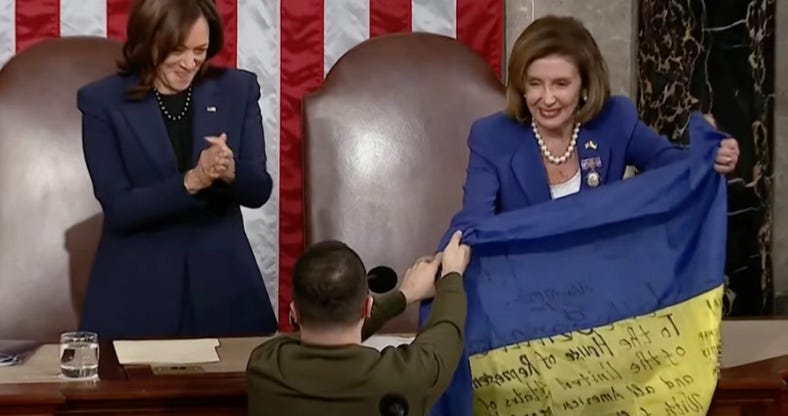
The British minister of state at the UK Ministry of Defence said this week that the UK will provide Ukraine with armor piercing ammunition containing uranium. Putin responded this would “force Russia to act”, and has since stated Russia is moving nuclear weapons to Belarus, closer to the European bloc. Even if Russia loses Bakhmut in the Donbas, as looks certain, there’s no guarantee the defeat will bring about peace talks.
Yesterday more encouraging news arrived, with Putin announcing there’s been as yet no agreement to a Russian-Chinese military alliance.
What’s clear in historic studies of armed conflict is diplomatic peace is possible, only if all parties are willing to make compromises. The question is whether, with Zelensky’s claim that the war won’t end until Crimea is retaken, Europe and the U.S. are willing to follow suit — at the risk of nuclear escalation.
Humanitarian ship rescues 190 migrants
The humanitarian rescue ship Geo Barents operated by Médécins sans Frontières (MsF) rescued 190 migrants on Thursday night, including several unaccompanied minors. The rescue took place after another humanitarian ship, the Louise Michel, intervened to stabilize the migrant boat. This news represents the first hopeful story in weeks. Yesterday, on March 26th, instead more devastation: 29 migrants died in two boats off the coast of Tunisia.
Last Sunday another ship capsized while crossing from Libya to Italy. 17 people were rescued, 30 were missing.
Italy's inaction appears intentional
The most disturbing part of the deaths last Sunday was the ship had been calling for help for over 24 hours — and successfully alerted an NGO, Alarm Phone.
Alarm Phone passed on the ship’s precise coordinates, and informed a rescue control center in Rome there was a cargo ship nearby. Still Italian officials did nothing, the cargo ship was not redirected to the scene of the emergency.
Only when the NGO leaked images to the media of the boat being tossed by high waves did officials take action. Merchant ships were sent to the site (but not the coast guard). In the end, four ships were close by but only observed the situation for hours on end. When the ship Froland finally approached to attempt a rescue, the refugee boat capsized.
Alarm Phone is now charging Italy with responsibility for the deaths of 30 people with "the Italian authorities deliberately delaying rescue efforts" as weather conditions worsened hour by hour.
Demonstrations against Meloni's refugee policy
At the same time as the ship from Libya was capsizing, around 5,000 people demonstrated in Cutro, Calabria, against the refugee policy of the right-wing government under Giorgia Meloni, which led to the recent deaths on their coastline.
There’s talk that Meloni’s government wants to further tighten the penalties for smugglers, which has meant arrests of NGOs workers involved in sea rescue.
To give further context: from January 1 to March 10, about 18,000 people arrived in Italy by sea, compared to just 6,000 in the same period last year. Almost 3,000 people, mainly from Tunisia, arrived in Lampedusa on Friday and Saturday last week alone.
10 Years of Pope Francis Changed Climate Action
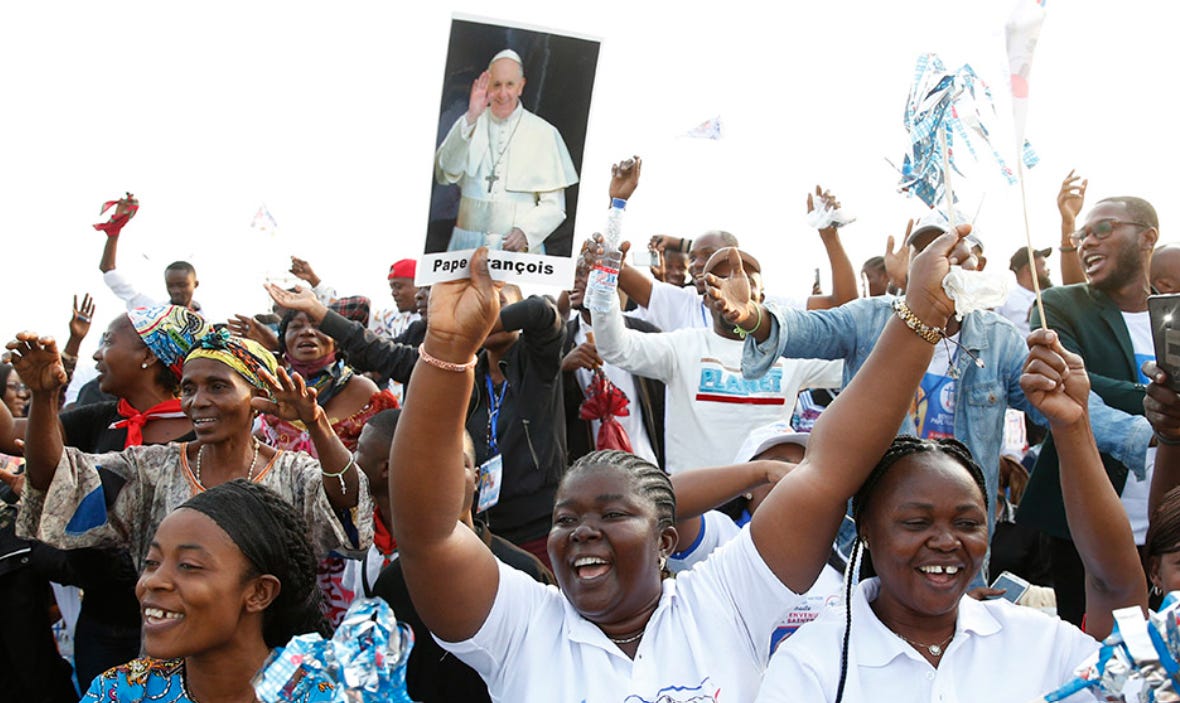
This month marked ten years of Pope Francis, during which he’s been entrenched in a struggle for the heart of the Catholic Church.
During this decade since he first appeared on St. Peter’s in plain white robes, he’s chosen to focus on inequality, the climate crisis and the plight of refugees, often disturbing more conservative followers. For his papacy, he chose to honor St. Francis, patron saint of ecology and animals, and in the last ten years brought many of the world’s 1.2 billion Catholics into alignment over humanity’s role in causing climate change.
In June 2015, he published Laudato Si’: On Care For Our Common Home, a document decrying environmental degradation and global warming, and critiquing consumerism and irresponsible development.
At this 10th anniversary, it’s curious to think why the dream of a new type of faith for a new world is still opposed by many.
“Ten years ago there was this retreat into defensive moralism. Francis has challenged that and focused on the heart of the gospel, which is the mercy of God and his preferential love for the poor … and on issues such as migration and the ecological crisis.” (The Guardian)
More Humanitarian & Climate News
Climate
New German Environment Minister calls for immediate transformation of lifestyle and economy
The EU Commission warns of drought in southern and western Europe
Effects of climate change greater than assumed
Germany doubling earthquake aid for Turkey and Syria
Germany, Spain push to keep nuclear out of EU renewable energy goals
First major fire of year destroys 3,000 hectares in Spain
EU Commission wants to extend gas emergency plan
Humanitarian & Migration
U.S. levels accusations of war crimes and crimes against humanity in Ethiopia
UNICEF: Water crisis endangers 190 million children.
Macron is no longer even trying to play the modernizer of the social state
Modi’s government muzzled India’s media through arrests, tax raids
Land grabbing in Africa’s cities creates a mirror of inequality
Persistent Violence in Israel-Palestine Could Escalate Further
At the End of a Hard Journey, Migrants Face Another: Navigating Bureaucracy
Training and Funding
Community by Design (CxD) grant at New_Public
European Prize for Humanitarian Innovation: first edition kicks off
Call for Applications: The Maintainers Movement Fellowship 2023
Exploring Principles of Feminist Leadership Training Online/Hybrid/Kenya
Monitoring, Evaluation, Accountability and Learning Training May 3 - 30th
Summer School on Migration and Human Rights, 10-14 July 2023, Rome (Italy) - Deadline for application: 27 June 2023
Jobs